Website Personalisation: The Complete Guide for Marketers
What website personalisation actually means, how the technology works and how to create more relevant experiences without making your marketing unnecessarily complicated.
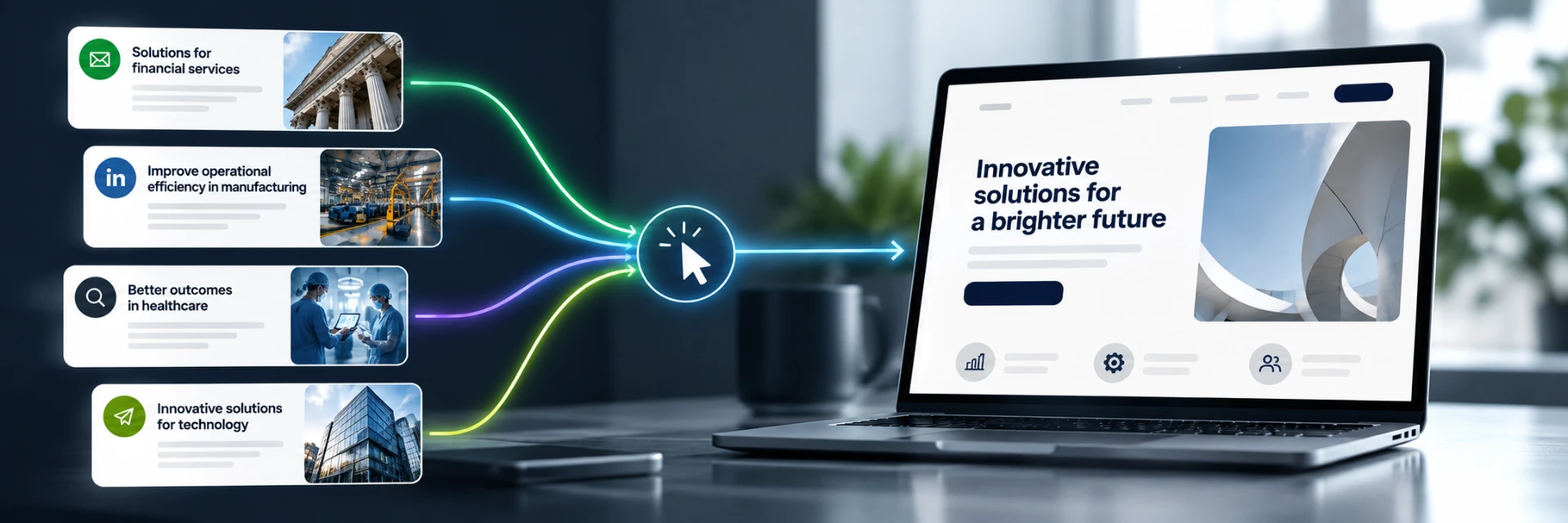
Most corporate websites are built around a straightforward assumption: everyone visiting a particular page will see essentially the same content. The navigation, headlines, imagery and calls to action are designed to communicate a proposition broad enough to appeal to different audiences.
It's a reasonable approach when little is known about the visitor. But increasingly, marketers do know something about the people arriving on their websites. They may know which campaign attracted them, the industry being targeted, the business challenge addressed in an email or the account involved in a sales conversation.
That information creates an opportunity to make the destination experience more relevant. Instead of presenting a broad proposition and expecting visitors to find the information that matters to them, marketers can adapt selected elements of the page to reflect the context in which someone arrived.
This is the principle behind website personalisation. And while the underlying technology can become sophisticated, effective personalisation doesn't necessarily require complex integrations, individual visitor identification or an entirely different website for every audience.
For many marketing teams, the most useful starting point is considerably simpler: make the content of an existing page more relevant to the people you're already targeting.
What is website personalisation?
Website personalisation is the practice of adapting website content or experiences according to information about a visitor, audience or campaign.
The information used might relate to an industry, organisation, buying role, campaign source or previous interaction. Depending on the approach, it can influence which headlines, images, supporting messages, offers or calls to action are displayed.
Consider a technology provider serving financial services, manufacturing and healthcare organisations. The underlying product might be relevant to all three industries, but the business challenges it addresses are different.
A financial services visitor may be primarily concerned with resilience, compliance and operational risk. A manufacturing visitor may be focused on production continuity and efficiency. Someone working in healthcare might be interested in connectivity, service availability and operational reliability.
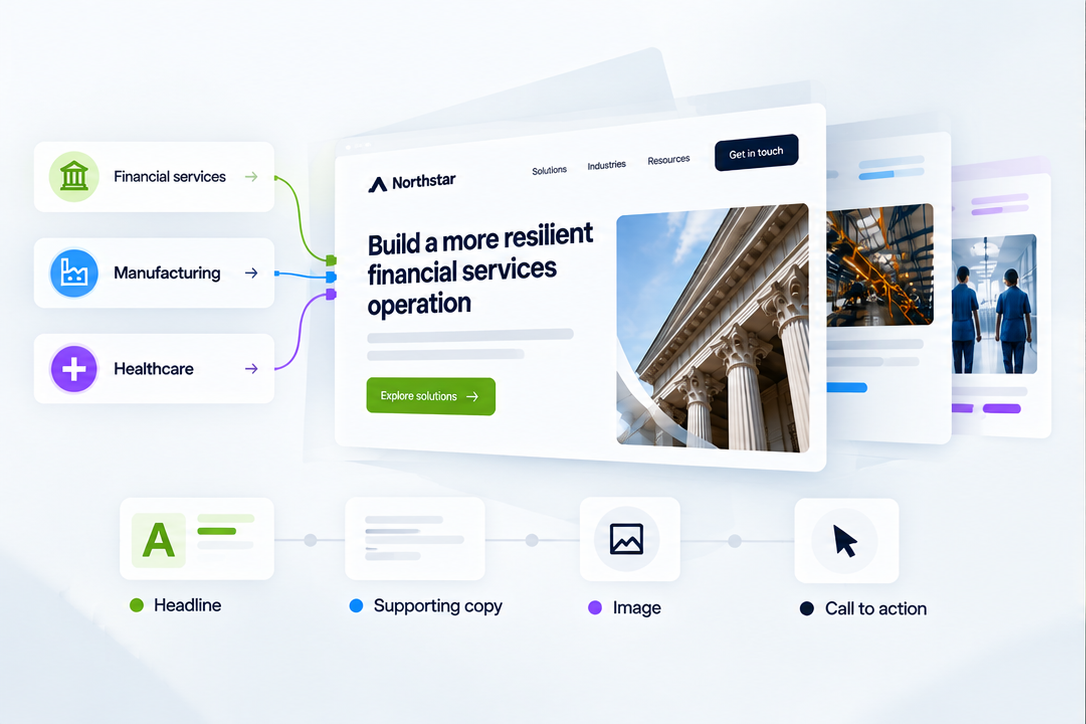
The company doesn't necessarily need three completely different product pages to communicate those distinctions. A single page could retain its core structure and product information while presenting an introduction that reflects the audience.
For example:
| Audience | Personalised headline |
|---|---|
| Default visitor | Technology that helps organisations operate with confidence |
| Financial services | Build resilience into your financial services infrastructure |
| Manufacturing | Reduce disruption with more reliable manufacturing technology |
| Healthcare | Support connected, resilient healthcare operations |
The content variations don't change the fundamental proposition. They make its relevance easier to recognise.
This is an important distinction because personalisation is sometimes confused with displaying someone's name or company logo. Those details can be useful in the right context, but they aren't the defining feature of a personalised experience.
Effective personalisation is about relevance, not simply recognition.
A page that addresses the visitor's actual business challenge may be considerably more useful than one that greets them by name but otherwise delivers generic content.
One page. Multiple experiences.
The same underlying page, adapted for different audiences.
Build operational resilience across financial services
Financial servicesReduce downtime and improve manufacturing performance
ManufacturingConnect systems and improve healthcare delivery
Healthcare
Why website personalisation matters
Marketing has become increasingly capable of reaching specific audiences with tailored propositions. Demand generation teams segment campaigns by industry and business challenge. Account-based marketing programmes focus on selected organisations and buying committees. Sales teams develop outreach based on individual conversations and account priorities.
Yet the corporate website often remains relatively static, even when the visitor has arrived through a campaign designed around a very specific need.
That disconnect can create unnecessary friction. Someone who clicks an email about reducing manufacturing downtime may arrive on a product page that talks broadly about technology transformation. The visitor must then determine which parts of the proposition address the challenge that originally attracted their attention.
A personalised experience can reduce that effort by maintaining the context established in the campaign. It can also make navigation more intuitive, direct visitors towards relevant supporting information and present a next step suited to the purpose of their visit.
There are operational benefits as well. Rather than creating and maintaining separate landing pages for every audience segment, marketers may be able to reuse existing pages and adapt selected elements.
None of this guarantees higher conversion rates. A more relevant headline cannot compensate for a weak offer, confusing page structure or poor-quality traffic. However, it provides a sensible hypothesis to test: visitors may be more likely to engage when the destination clearly addresses the reason they arrived.
For a deeper examination of this problem, see The Personalisation Gap: Why Relevance Disappears After the Click.
The main types of website personalisation
Website personalisation can be implemented at different levels of sophistication. The right approach depends on what you know about your audience, how reliably you can identify the relevant segment and what you're trying to achieve.
Campaign-based personalisation
Campaign-based personalisation uses information about the marketing activity that brought a visitor to the website.
For example, a technology company might run separate campaigns promoting operational resilience and cost optimisation. Both campaigns could lead to the same underlying product page, with the headline and supporting copy changing to reflect the proposition that prompted the visit.
The audience doesn't need to be individually identified. The campaign link itself can provide enough information to select the appropriate variation.
This makes campaign-based personalisation a practical starting point for demand generation, paid media and email marketing, particularly where marketers already maintain distinct campaigns for different propositions.
Industry-based personalisation
Industry personalisation adapts content according to the sector being targeted.
A cybersecurity provider, for example, might emphasise regulatory requirements for financial services, operational continuity for manufacturing and sensitive information protection for healthcare.
The underlying capabilities of the product may remain broadly similar, but the benefits can be expressed in terms that matter to each audience.
This approach is useful when the business serves several sectors and the industry of a campaign audience is known reliably. It is also relatively straightforward to manage because a small number of industry variations can support multiple campaigns.
Account-based personalisation
Account-based personalisation takes relevance further by adapting content for specific organisations or groups of organisations.
In a 1:Many ABM programme, this might involve shared experiences for accounts with similar characteristics. In a 1:Few programme, the content could reflect common strategic priorities among a smaller cluster of accounts. For a 1:1 programme, a personalised link could present messaging associated with an individual organisation.
The content might reference an account's known business priorities, relevant technology requirements or the context of an ongoing sales conversation.
However, account-specific content should be based on reliable information. Inserting a company name into a webpage is straightforward; making claims about that company's priorities without supporting evidence is considerably less useful.
Personalisation also needs to account for the possibility that links will be forwarded. A visitor possessing an account-specific URL should not automatically gain access to confidential information.
Individual-level personalisation
Individual personalisation adapts content using information associated with a particular contact.
That information could include a name, organisation, department or other relevant attributes available through a marketing database or suitable campaign identifier.
It can be useful for email campaigns, event follow-up and personalised sales outreach, especially where the destination needs to continue a specific conversation.
But individual identification introduces additional responsibility. Marketers need to consider the quality and provenance of the data, applicable privacy requirements and whether displaying a particular detail genuinely improves the experience.
A relevant proposition usually matters more than proving how much information you hold about someone.
Behavioural personalisation
Behavioural personalisation uses previous interactions to influence the experience.
An ecommerce website might highlight products related to categories someone has explored. A content-rich B2B website could recommend resources associated with previously viewed topics, provided the necessary data and permissions are available.
This approach can be valuable, but it is often more technically demanding. It may require event tracking, visitor recognition, consent management and reliable rules for interpreting behaviour.
For organisations beginning with website personalisation, campaign or audience-based approaches are frequently easier to implement and evaluate.
How website personalisation actually works
Although platforms differ in their architecture and capabilities, most personalisation processes involve four stages: identifying the relevant audience, selecting the appropriate variation, displaying the content and measuring the outcome.
How website personalisation works
Four steps to a more relevant website experience.
- 01IdentifyRecognise a visitor or audience using available signals.
- 02MatchApply the relevant audience and campaign rules.
- 03PersonaliseDisplay the appropriate content variation.
- 04MeasureEvaluate engagement and conversion outcomes.
1. Identify the visitor or audience
The first requirement is a reliable signal that indicates which experience should appear.
For campaign-based personalisation, this might be information included in the destination URL. For example, an industry campaign could direct visitors to:
example.com/solutions?industry=manufacturing
A platform configured to recognise the industry parameter can use that value to determine the relevant content.
For more targeted programmes, an identifier might be associated with an account or contact record. Other approaches may use behavioural information or suitable integrations with marketing systems.
These options are not interchangeable. Each has different requirements for data accuracy, visitor recognition and privacy.
Importantly, individual identification isn't always necessary. If the objective is simply to show manufacturing-specific messaging to visitors from a manufacturing campaign, the campaign link may provide all the information needed.
2. Match the visitor to a content variation
Once the platform has information about the audience, it applies rules to decide which content should be displayed.
A simple rule might specify that visitors associated with manufacturing see one headline, while visitors associated with financial services see another.
More complex programmes may combine several attributes, such as industry, buying role and campaign.
This introduces an operational consideration: what happens when several rules could apply to the same visitor?
Personalisation needs a clear approach to precedence and fallback behaviour. Marketers should understand which rule takes priority and ensure that an appropriate default experience appears when the available information doesn't match a defined variation.
Without that discipline, adding more rules can make campaigns difficult to predict and maintain.
3. Display the personalised content
The platform then delivers the selected experience.
Depending on the technology, content changes may be applied on the server, at the network edge or within the visitor's browser. These approaches have different implications for performance, implementation and compatibility with the existing website.
Some platforms require changes to templates or backend applications. Others can adapt selected page elements using a script installed on the website.
For marketers evaluating a no-code solution, the practical questions are whether content can be selected and edited visually, how the website is initially connected, and how reliably the variations appear.
A visual editor may reduce the need for ongoing development, but it doesn't eliminate the need to consider page structure, loading behaviour, accessibility or quality assurance.
4. Measure what happens
The final stage is determining whether the personalisation helped achieve its purpose.
For an acquisition campaign, that might involve form submissions or qualified enquiries. For ABM, account engagement and opportunity progression may matter more. For an ecommerce campaign, purchases or order value could be more relevant.
Measurement should be considered before launching the variation, not added as an afterthought.
Without a clear objective and suitable comparison, marketers risk investing effort in content variations that look interesting but contribute little to performance.
Do you need a different landing page for every audience?
Separate landing pages remain a valid approach. They're particularly useful when campaigns need substantially different layouts, offers, forms or conversion journeys.
The difficulty arises when dozens of pages are created primarily to accommodate relatively small differences in audience messaging.
Consider a programme involving five industries, three buying roles and four propositions. If every combination required a distinct destination, there could be 60 potential audience combinations.
Campaign complexity without personalisation
How quickly separate landing pages can add up.
- 5Industries
- 3Buying roles
- 4Propositions
That doesn't mean the organisation needs 60 separate pages, or even 60 distinct content variations. Some combinations may not be commercially relevant, while others may be able to share the same proposition.
But the example illustrates how quickly campaign complexity can grow.
Dynamic personalisation allows marketers to separate the underlying page from the audience-specific messages displayed within it. A common page structure can support several headlines, supporting paragraphs, images or calls to action.
This can reduce duplicated work, particularly when the same product information is used across multiple campaigns.
However, personalisation isn't a substitute for good content planning. Someone still needs to decide which audiences genuinely require different messages, create those messages and test whether the resulting experiences make sense.
The objective should be to simplify campaign delivery, not create unnecessary complexity within a single page.
What should you personalise first?
One of the most common mistakes is attempting to personalise too much before establishing which changes deliver value.
A more manageable approach is to select the elements most closely connected to the reason a visitor arrived.
Start with the headline
The headline is often the clearest opportunity to reinforce campaign relevance.
A generic headline such as "Technology solutions for modern businesses" may accurately describe the company, but it does little to connect with a specific audience.
For visitors from a manufacturing resilience campaign, "Reduce disruption with more reliable manufacturing infrastructure" creates a more direct relationship between the campaign and the destination.
The message should still be accurate and supported by the rest of the page.
Adapt the supporting message
A personalised headline is less useful if the paragraph immediately beneath it returns to an unrelated generic proposition.
Supporting copy should explain the relevant benefits and help visitors understand how the solution addresses their needs.
This doesn't require rewriting every paragraph. In many cases, a focused introduction can establish the context while the core product information remains consistent.
Review the imagery
Images can reinforce an audience-specific proposition, especially where sectors or use cases have recognisably different environments.
For example, an image reflecting a manufacturing setting might support a campaign about industrial operational resilience, while an image associated with financial services could reinforce a proposition about secure infrastructure.
But relevant imagery should complement substantive messaging. It shouldn't become the only evidence of personalisation.
Make the next step appropriate
Calls to action can also reflect the visitor's context.
Someone exploring a solution for the first time may benefit from a guide or explanatory resource. A known prospect returning after a sales meeting may be more interested in a demonstration or follow-up conversation.
Changing a call to action can affect the conversion journey, so these variations deserve particular care in testing and measurement.
Common mistakes to avoid
Website personalisation can become unnecessarily complicated when teams focus on how much content they can change rather than why it should change.
The first mistake is personalising without a clear purpose. A visitor's name or company logo may create recognition, but it won't necessarily make the proposition more compelling. Every variation should address a meaningful difference in audience needs or campaign context.
A second problem is creating too many variations. More content creates additional work for writers, reviewers and campaign managers. It also introduces more rules, interactions and opportunities for inconsistency. Starting with a limited number of well-defined audiences is usually more manageable.
Unreliable identification is another risk. Incorrectly matching someone to an industry, account or individual can deliver irrelevant content, and displaying the wrong company's name may undermine credibility. A reliable default experience is essential.
Teams must also consider privacy and data handling. Personal information should not be exposed unnecessarily in URLs or analytics systems, and sensitive account information should never rely on a personalised link alone for protection. The applicable requirements depend on how visitor information is collected, processed and used.
Finally, personalisation needs proper quality assurance. Headlines can have different lengths, images may change proportions and page elements may behave differently on mobile devices. Every important variation should be previewed and tested before launch, including the standard experience shown when no rule matches.
Measuring whether personalisation is working
The right measurement approach depends on what the campaign is intended to achieve.
For demand generation, a useful starting point might be the conversion rate from visit to qualified enquiry. For an event campaign, registrations and attendance may matter more. In ABM, engagement by target account and progression towards a commercial opportunity can provide a more meaningful view than individual page conversions.
Where possible, compare personalised experiences with a suitable control group that receives the standard version of the page. This helps distinguish the effect of the variation from broader changes in campaign performance.
The comparison should be designed carefully. Differences in traffic quality, campaign source, offer or timing can influence the results. Small samples can also produce apparent improvements that aren't statistically reliable.
Marketers should look beyond immediate conversions where appropriate. A more relevant page might improve the quality of enquiries or make subsequent sales conversations more productive, even if the total number of submissions changes only slightly.
There is also a separate operational question worth measuring: how much effort does the personalisation approach require?
If a marketing team can deliver relevant campaign variations more quickly and maintain them with less duplication, that may represent a worthwhile efficiency improvement. It should be considered alongside commercial outcomes rather than assumed to guarantee them.
How to get started with website personalisation
The most effective first project is usually one where the audience is clearly defined, the messaging difference is meaningful and the outcome is measurable.
Begin with a campaign already using distinct audience segments, such as a product promotion targeting two or three industries. Identify an existing destination page and decide which content elements could be made more relevant without changing the underlying proposition.
Next, establish how the website will recognise those audiences. Campaign parameters may be sufficient, avoiding the need for individual identification or complex integrations. Define the default experience and make sure the rules behave predictably.
Create a small number of variations, focusing first on the headline and supporting message. Add imagery or different calls to action only where they make a useful contribution.
Before launching, follow the complete visitor journey for each audience. Check the campaign link, the displayed content, mobile layout and conversion path. Confirm that visitors who don't match a rule still see a coherent page.
Finally, evaluate the results against the original objective. Use what you learn to decide whether to expand to more audiences, additional pages or more sophisticated personalisation.
This approach builds a repeatable capability without requiring marketers to begin with a large implementation programme.
Making website personalisation more accessible
Historically, website personalisation has often required a combination of development resources, dedicated landing pages and specialist technology. Those requirements have made it difficult for some marketing teams to experiment with audience-specific content at scale.
Modern no-code approaches offer an alternative by allowing marketers to manage selected content variations on existing webpages.
That's the principle behind Marketing Guppy.
Marketing Guppy is designed to help marketers personalise headlines, images and other content on their existing pages using audience and campaign information. Once the necessary website setup is complete, teams can create and manage relevant variations through a visual workflow rather than building a new page for every campaign.
This can support demand generation, ABM, email marketing and sales outreach, where marketers often already know enough about the audience to communicate more specifically.
The aim isn't to personalise every element for every visitor. It's to make the parts of the experience that matter more relevant, while keeping the process manageable.
Relevance should be built into the experience
Website personalisation is ultimately a way of applying audience understanding to the experience visitors receive.
It can be as simple as adapting a headline for an industry campaign or as sophisticated as coordinating content around a strategic account. The right level depends on the marketing objective, the quality of the available information and the effort required to maintain the experience.
The important thing is to begin with the visitor's needs rather than the capabilities of the technology.
A relevant message, delivered at the right moment and supported by a useful destination, is more valuable than personalisation for its own sake.
For marketers, that's the opportunity: to make the website a more active part of campaign relevance, rather than treating it as a fixed destination.