The Personalisation Gap: Why Relevance Disappears After the Click
Marketing has become remarkably sophisticated at reaching the right people. So why do so many campaigns still send them to a website that treats everyone exactly the same?
Consider the amount of work that goes into a modern B2B marketing campaign. Teams identify the organisations they want to reach, segment them by industry and business challenge, map the stakeholders involved in purchasing decisions and develop messages intended to resonate with each audience. Data, intent signals and marketing automation make it possible to deliver that messaging with increasing precision.
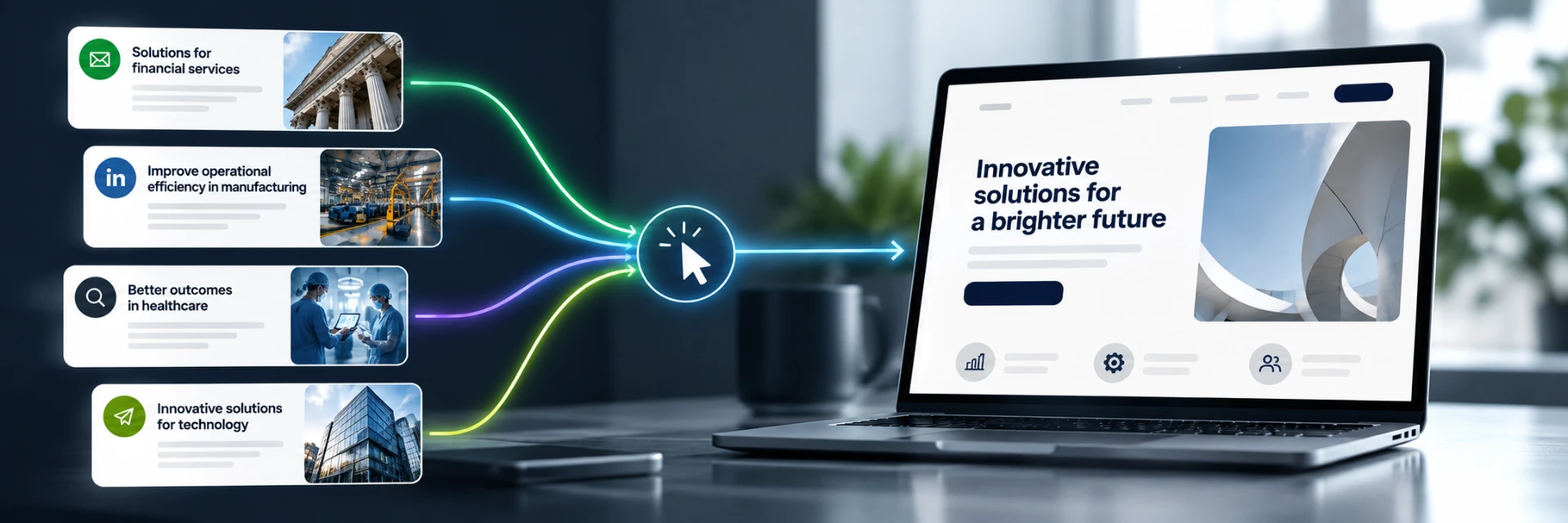
Yet there is often a disconnect between the sophistication of the campaign and the experience waiting at its destination. A financial services executive responding to a message about operational resilience can arrive on exactly the same webpage as a manufacturing leader interested in reducing downtime. The headline, imagery and supporting proposition make little reference to either challenge.
The campaign has done its job of attracting a relevant visitor, but the website asks that visitor to work out the relevance all over again.
This is the personalisation gap: the point at which the context established through targeting and messaging is lost between the campaign and the website. It's an increasingly important weakness in digital marketing, particularly for organisations investing heavily in account-based marketing, demand generation and audience intelligence.
Campaign targeting has moved forward. The destination experience hasn't always followed.
Marketers have far more information available to them than they did a decade ago. They can identify target accounts, understand which topics those organisations are researching, segment contacts by buying role and adapt campaigns to particular business priorities.
That intelligence increasingly shapes what happens before a visitor reaches the website. Advertising messages vary by audience. Email campaigns use CRM and marketing automation data to tailor content. Sales teams conduct highly specific outreach based on account plans and previous conversations.
These capabilities represent substantial investment, but they also expose an inconsistency. The visitor's experience is carefully considered throughout the targeting and engagement process, then frequently becomes generic at the moment of arrival.
It's not that a generic website is necessarily ineffective. A well-designed corporate page can explain a proposition clearly and serve a broad range of visitors. The question is whether it is the most appropriate destination for someone whose interests and context are already known.
For a visitor responding to a highly targeted campaign, a broad corporate message may be a step backwards. Instead of building on their initial interest, the page requires them to navigate towards the information that brought them there in the first place.
This distinction matters because successful targeting and a relevant destination are not the same thing. Reaching the right people creates an opportunity. What they experience next determines whether that opportunity is developed.
The cost of losing relevance
Imagine a technology provider running two demand generation campaigns for the same underlying infrastructure solution.
The first targets financial services organisations and focuses on regulatory resilience, business continuity and reducing operational risk. The second targets manufacturing companies and addresses production disruption, operational efficiency and the cost of downtime.
Both campaigns are relevant to their respective audiences. Both generate clicks to the company's website.
If the destination leads with "Transform your business with innovative technology solutions", it may be factually correct, but it gives neither audience much indication that their particular challenge is understood.
Now consider an alternative. Financial services visitors arrive on a page headed "Build a more resilient financial services operation", while manufacturing visitors see "Reduce downtime with more reliable technology infrastructure".
The underlying product and webpage can remain the same. The difference is that each visitor encounters a proposition directly connected to the reason they clicked.
That connection can make the experience easier to understand. It can reduce the effort required to locate relevant information and help the visitor decide whether the offer is worth exploring.
It doesn't guarantee a conversion, and the quality of the underlying offer still matters. But maintaining the context of a campaign gives the destination page a more useful starting point than a message intended to appeal to everyone.
Why hasn't website personalisation become standard practice?
If tailoring a destination page is so logical, why do so many marketing programmes still rely on generic experiences?
The answer is partly operational.
Marketing teams may control campaign messaging, advertising creative and email content, but the corporate website often has its own technology, governance and publishing processes. Even relatively simple changes can involve development teams, design approval, content management workflows and testing.
Creating separate landing pages has traditionally been one way around the problem. Marketers can produce dedicated destinations for important campaigns without changing the broader website.
That approach works, particularly when campaigns are limited in number or require genuinely distinct content and conversion journeys. But it becomes more difficult as the number of audiences and messages grows.
Consider an account-based marketing programme targeting five industries, three buying roles and several business propositions. Creating a separate landing page for every combination could result in dozens of pages, many differing only in their headlines, supporting copy and imagery.
Each page needs to be created, tested, maintained and updated when the proposition changes. That can become a disproportionate amount of work for relatively small variations in messaging.
There is also a consistency problem. As campaign pages multiply, outdated content, inconsistent calls to action and different versions of the same proposition become harder to manage.
It's understandable that marketing teams often compromise by building a handful of broader landing pages. But the trade-off is that some of the relevance established during targeting is inevitably lost.
One page can support different experiences
Dynamic website personalisation offers an alternative to creating separate destinations for every audience.
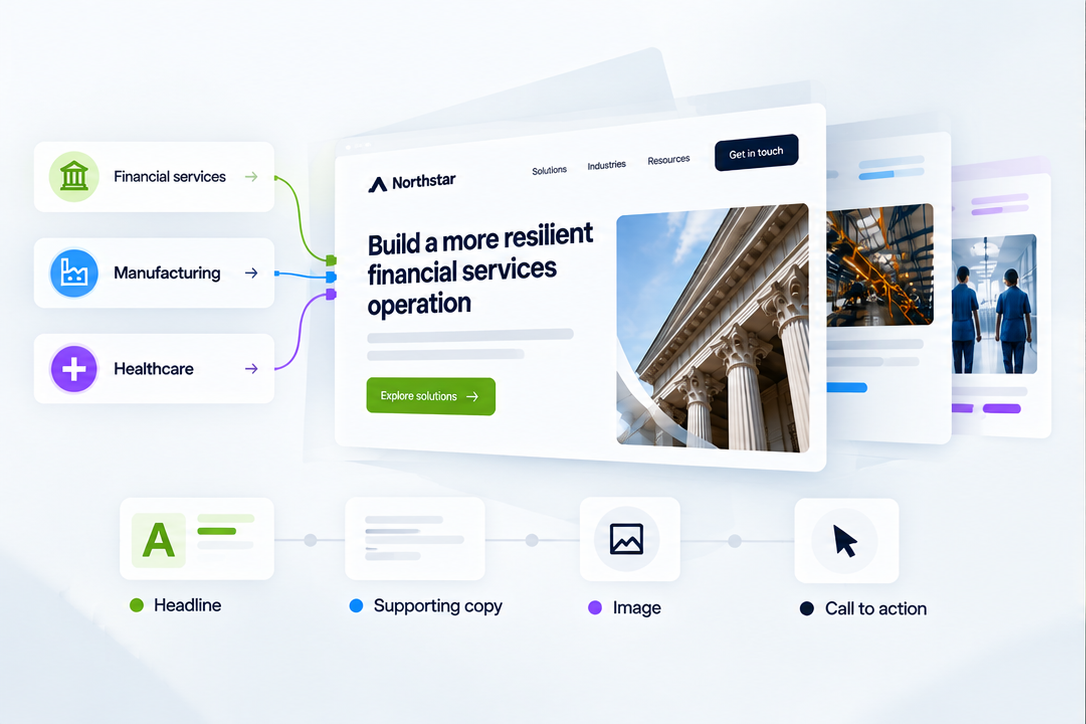
Instead of duplicating an entire page, marketers can adapt selected elements of an existing webpage using information about the visitor, campaign or audience segment.
A headline might change to reflect the visitor's industry. Supporting copy could address a relevant business challenge. Imagery might reinforce the proposition, while the call to action could reflect the campaign's objective.
The page's underlying structure, navigation and core information can remain consistent.
For example, the financial services and manufacturing campaigns described earlier could use the same product page. Each campaign link provides the information needed to select the appropriate content variation, while visitors who don't match a defined audience continue to see the standard page.
This is an important distinction. Personalisation doesn't have to mean identifying every individual visitor or creating a unique experience for every contact. In many cases, knowing which audience or campaign brought someone to the page is enough to make the messaging more relevant.
For more targeted programmes, additional information can support account-specific or individual-level experiences, provided it is reliable and appropriate to use.
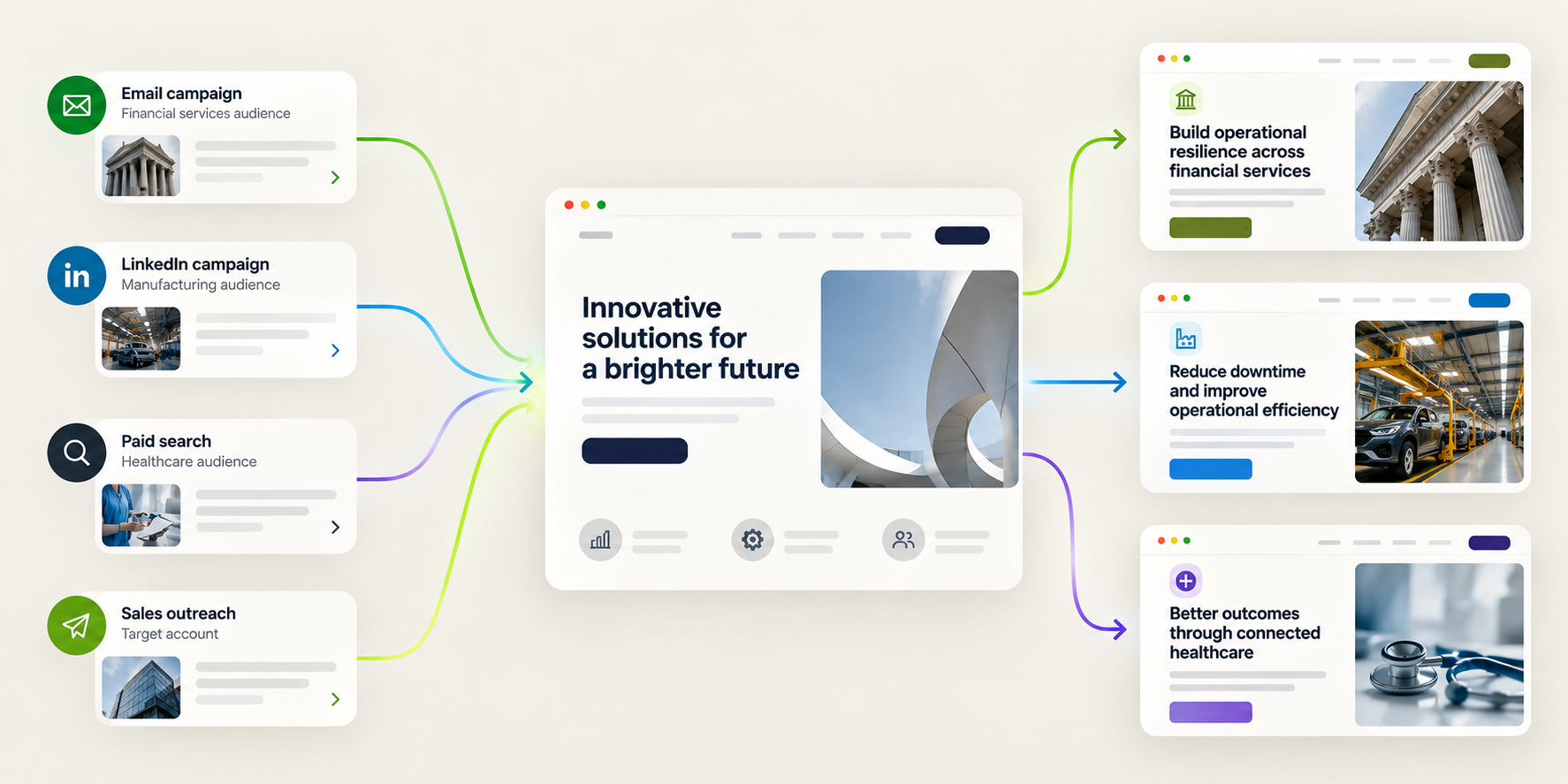
Modern personalisation tools increasingly make this kind of variation accessible through visual editing rather than requiring custom development for every campaign. An initial website integration or technical approval may still be necessary, but the ongoing work of creating and managing content variations can become a marketing responsibility.
That changes the economics of relevance. Instead of weighing the potential benefit of every new message against the cost of building another landing page, marketers can make more focused decisions about which parts of an existing experience are worth adapting.
The opportunity extends well beyond account-based marketing
Website personalisation is often discussed in the context of enterprise ABM, where organisations invest heavily in understanding and engaging a defined set of accounts. It's a natural application, but far from the only one.
For demand generation, industry and campaign-based variations can help maintain consistency between advertising, email and destination pages. A single product or service page can support multiple audience segments without requiring a separate destination for each.
In account-based marketing, relevant content can be tailored to account clusters, strategic organisations or particular buying roles. The value comes from reflecting meaningful business priorities, not simply displaying a company logo.
For sales outreach, a personalised link can extend the context of an account executive's message or meeting follow-up. Rather than directing someone to a general services page, the link can present a more relevant introduction to the appropriate proposition.
In email marketing, dynamic imagery and personalised messages can be connected to destination content so that the experience feels consistent from inbox to website.
And for B2C campaigns, audience-based variations can reflect product interests, campaign offers or customer segments where the available information supports it.
These applications differ in scale and complexity, but they share a common principle: use what you know about the visitor's context to make the next interaction more relevant.
Does a more relevant experience actually improve results?
It's tempting to assume that personalised website content will automatically increase conversion rates. Relevance is a sensible objective, but its commercial impact needs to be demonstrated rather than presumed.
A personalised headline may help a visitor recognise that a page addresses their needs. Whether that leads to a form submission, meeting or purchase depends on many other factors, including the strength of the offer, the credibility of the supporting content and the quality of the overall experience.
Personalisation can also be executed badly. Incorrect audience identification may display irrelevant content, while excessive use of personal information can make visitors uncomfortable. A company name inserted into a generic proposition may create recognition without adding meaningful value.
The most useful approach is to treat personalisation as a hypothesis to test.
Start with an existing campaign where the audience is clearly defined and the desired outcome is measurable. Create a variation that addresses a genuine difference in audience needs, then compare its performance with a suitable control.
For a demand generation campaign, useful measures might include qualified enquiries, form completions and downstream opportunity creation. For ABM, account engagement and progression towards commercial conversations may be more meaningful than aggregate conversion rates.
It is also worth monitoring the operational side of personalisation. If marketers can create and maintain relevant experiences more efficiently, that benefit may be valuable even when short-term conversion improvements are modest.
The objective should be better campaign performance and more useful experiences, not simply demonstrating that website content can change dynamically.
The next opportunity is to connect targeting with experience
Marketing investment has increasingly concentrated on improving the quality of audience selection and campaign engagement. Better data, more precise segmentation and increasingly sophisticated automation have helped organisations communicate with greater relevance.
But the experience after the click deserves the same attention.
A campaign should not be evaluated only by whether it reaches the right people and persuades them to visit. The destination also has a responsibility to continue the proposition that attracted them and make the next step clear.
For marketing teams, the opportunity is to bring those activities closer together. Audience intelligence can inform the campaign message and the website experience, rather than being used for one and abandoned at the other.
This is the thinking behind Marketing Guppy. By allowing marketers to personalise content on existing webpages and create tailored campaign imagery, Marketing Guppy is designed to help connect audience targeting with the experience visitors receive.
It isn't about turning every website into a collection of individually customised pages. It's about making relevant changes where they matter, using the audience and campaign information marketers already have.
The result is a more joined-up approach to digital marketing: one in which the relevance established before the click has a better chance of surviving it.